Garage Door Maintenance Checklist for New Homeowners
Buying a home comes with a long list of “new responsibilities,” and the garage door is one of the most overlooked—until it becomes a problem. But here’s the truth: your garage door is a heavy, moving system with springs under serious tension, rollers that cycle thousands of times, and safety sensors that protect kids, pets, vehicles, and, frankly, your sanity.
The good news? You don’t need to be a garage door technician to keep your system running smoothly. With a simple routine and a few quick inspections, you can prevent common issues that lead to expensive repairs—like broken springs, frayed cables, loud operation, track problems, or an opener that suddenly quits.
This guide gives new homeowners a comprehensive garage door maintenance checklist (the kind you can actually follow), plus specific tips for different garage door types—steel, wood, insulated, and modern full-view doors.
And if you’re ever unsure what you’re seeing, Rose Quality Garage Doors is here for garage door repair and garage door installation across Nashville, Murfreesboro, Franklin, Clarksville, and Knoxville, TN.
First: A Quick Safety Note (Important)
There are a few things homeowners should not DIY on a garage door system:
- Torsion springs and extension springs
- Lift cables
- Bottom brackets (often under spring tension)
- Major track resets
- Any repair involving a door that’s off-track or hanging crooked
Springs and cables can be dangerous if handled incorrectly. The checklist below focuses on safe homeowner maintenance—and clearly calls out when to schedule a professional garage door service visit.
Garage Door Maintenance Schedule at a Glance
Use this simple cadence:
- Monthly: quick visual and safety checks (5–10 minutes)
- Quarterly: lubricate key moving parts + inspect seals (10–20 minutes)
- Twice a year (spring/fall): deeper inspection and tune-up checks (20–30 minutes)
- Annually: professional inspection if you use the door heavily or notice issues
If you’re in Tennessee, spring and fall are perfect times to do a deeper check because temperature swings can reveal alignment and seal problems.
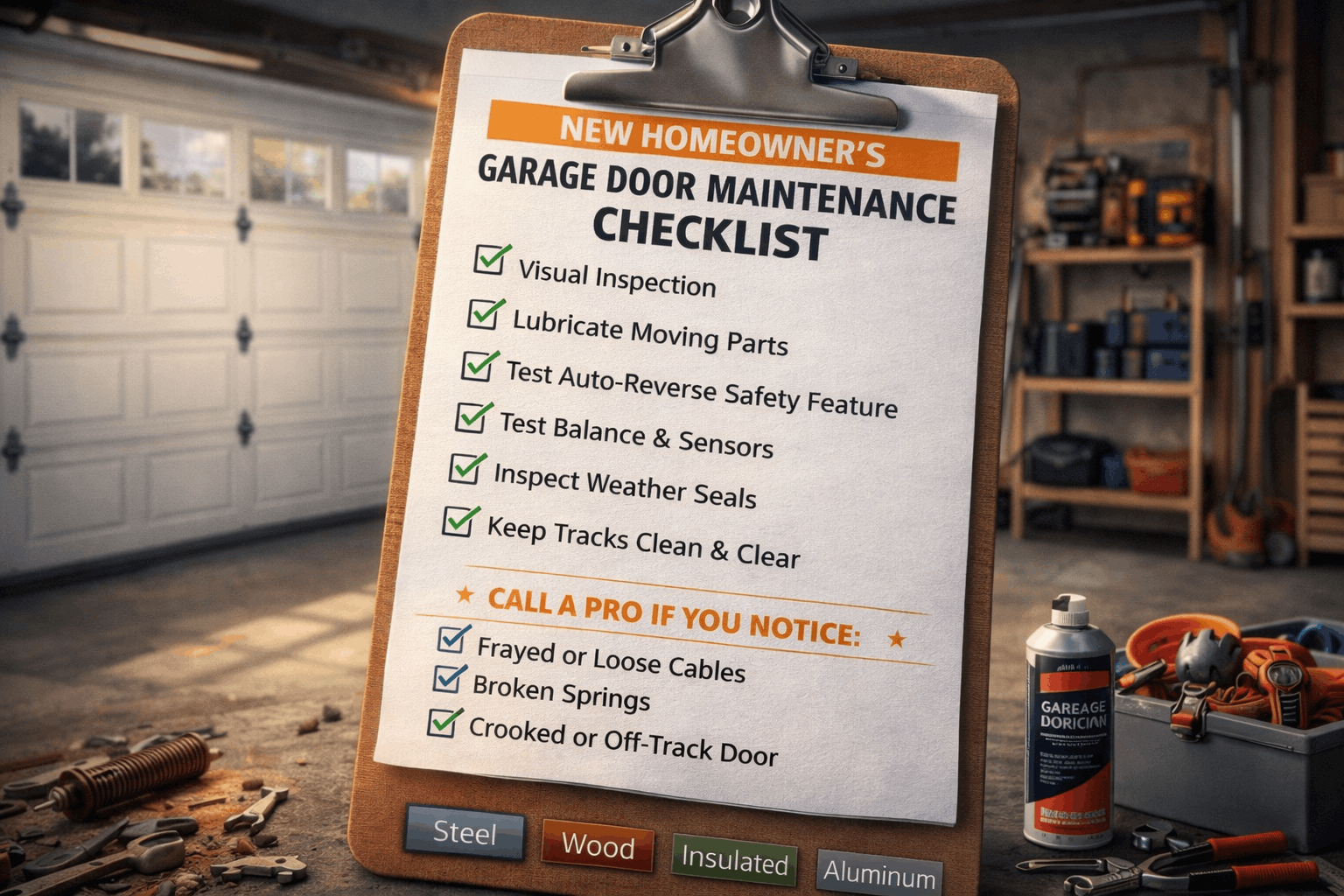
The New Homeowner’s Garage Door Maintenance Checklist
✅ 1) Visual Inspection (Monthly)
Walk through the garage and look over the system with the door closed.
Check for:
- Loose bolts or hinges
- Bent tracks
- Rust on hinges, springs, or hardware
- Frayed cables (look—don’t touch)
- Cracked rollers (nylon rollers can split)
- Gaps around the door perimeter
- Damage on panels (dents, warping, rot on wood)
If you see: frayed cables, significant rust on springs, or the door looks crooked in the opening—stop and schedule a professional garage door repair inspection.
✅ 2) Listen for Changes (Monthly)
Operate the door and listen.
A healthy door should sound smooth and consistent. What you don’t want:
- Grinding
- Screeching
- Loud popping or banging
- Heavy vibration/rattling
- Jerky movement
These noises often point to rollers, hinges, track alignment, or balance issues—small problems that can become big repairs if ignored.
✅ 3) Test the Auto-Reverse Safety Feature (Monthly)
This is one of the most important checks for families.
How to test:
- Open the door fully.
- Place a 2×4 piece of wood flat on the ground in the door’s path.
- Close the door using the opener.
- The door should reverse immediately when it touches the wood.
If it doesn’t reverse, your opener may need adjustment or service. This is worth addressing ASAP.
✅ 4) Test the Photo-Eye Sensors (Monthly)
These are the small sensors near the bottom of the track.
Check that:
- Both sensors are aligned and facing each other
- Indicator lights are steady (not blinking)
- Nothing blocks the beam
Test: close the door and wave a broomstick or box in front of the beam—door should reverse.
If sensors are misaligned or failing, that’s a common garage door repair call—and usually quick to fix.
✅ 5) Check Door Balance (Twice a Year)
A balanced door protects your opener and reduces wear on the entire system.
How to do it (safely):
- Close the door.
- Pull the red emergency release cord to disconnect the opener.
- Lift the door halfway and let go carefully.
- The door should stay in place or move very slightly.
If the door:
- Drops quickly → springs may be weak
- Shoots upward → springs may be too tight
- Feels heavy → spring tension is off
Balance issues lead to broken openers and spring failures. Call a pro for this—spring adjustments are not DIY.
✅ 6) Lubricate Moving Parts (Quarterly)
Proper lubrication reduces noise and prevents metal-on-metal wear.
Lubricate:
- Hinges (pivot points)
- Roller bearings (if metal rollers)
- Torsion spring (light coat)
- Bearing plates (ends of torsion tube)
- Opener rail (if your manufacturer recommends it)
Do NOT lubricate:
- Tracks (this attracts dirt and can cause slipping issues)
- Nylon roller “wheels” (lubricate bearings only if applicable)
Tip: Use a garage-door-specific lubricant or silicone-based spray. Avoid heavy grease.
✅ 7) Tighten Hardware (Twice a Year)
Garage doors vibrate—hardware loosens over time.
Using a socket wrench, snug up:
- Hinge bolts
- Track brackets (to the wall framing)
Do not overtighten—just snug. If you notice stripped wood or loose mounting points, that’s a sign to get a technician involved.
✅ 8) Clean Tracks and Door Surface (Twice a Year)
Tracks: wipe with a dry cloth or mild cleaner to remove buildup.
Door exterior: wash like you would a car—gentle soap, rinse, dry.
Keeping tracks clean helps rollers glide smoothly and reduces squeaks and binding.
✅ 9) Inspect and Replace Weatherstripping (Twice a Year)
Weatherstripping is huge for comfort and cleanliness—especially in Tennessee storms and humidity.
Check:
- Bottom seal (rubber strip under door)
- Side and top seals (vinyl perimeter weatherstripping)
Replace if:
- Cracked, flattened, torn, or missing chunks
- You see daylight around the edges
- Water/dust/leaves get inside regularly
New seals can improve energy efficiency, reduce pests, and keep your garage cleaner.
✅ 10) Confirm the Opener Is Working Properly (Twice a Year)
Your opener should lift smoothly without straining.
Watch for:
- Slow opening/closing
- Clicking but not moving
- Lights flashing repeatedly
- Door reverses randomly
- Remote range suddenly gets worse
Also check:
- Battery backups (if equipped)
- Keypad operation
- Wall button responsiveness
If you’re upgrading homes, pairing a new opener with a well-maintained door can dramatically improve daily reliability.
✅ 11) Check for Moisture and Rot (Wood Doors) (Quarterly)
If you have a wood garage door, your maintenance priorities shift.
Look for:
- Swelling
- Soft spots
- Peeling paint
- Dark staining near the bottom panel (water exposure)
Wood doors need consistent sealing/painting to prevent rot—especially at the bottom where splashback hits.
✅ 12) Keep the Door’s Path Clear (Always)
This seems obvious, but it’s one of the most common issues with new homeowners who are still organizing storage.
Make sure:
- Nothing blocks the sensor beam
- Storage isn’t leaning into the track
- Bikes/tools aren’t near the moving door
A single bump to a track can cause misalignment and create a future repair call.
Maintenance Tips by Garage Door Type
Steel Garage Doors (Most Common in TN)
Steel doors are durable and relatively low maintenance.
Best practices:
- Wash and inspect for dents and scratches
- Touch up paint chips to prevent rust
- Lubricate hinges/rollers regularly
- Replace bottom seal when it hardens
Watch for: rust near the bottom panel, especially if water pools near the garage threshold.
Insulated Garage Doors (Energy-Efficient Upgrade)
Insulated doors are quieter, more rigid, and often more comfortable—especially for attached garages.
Best practices:
- Maintain weather seals (this is where efficiency is won/lost)
- Keep door balanced (insulated doors can be heavier)
- Address small alignment issues early to prevent panel stress
Watch for: door “dragging” or straining—could mean balance/spring adjustment is needed.
Wood Garage Doors (High-Curb-Appeal, Higher Maintenance)
Wood doors look incredible but require protection from moisture.
Best practices:
- Inspect and repaint/reseal as needed
- Watch bottom edge for rot or swelling
- Keep sprinklers from hitting the door directly
- Maintain proper drainage at the threshold
Watch for: warping that causes uneven closing or air gaps.
Aluminum / Full-View Glass Doors (Modern Style)
These look amazing on contemporary homes but can show fingerprints and require careful cleaning.
Best practices:
- Use non-abrasive cleaner for glass
- Check hardware more often (lightweight doors still cycle a lot)
- Ensure weather seals remain intact (especially with glass panels)
Watch for: loose frame components or rattling if hardware loosens.
Carriage-Style Doors (Traditional Look)
Carriage-style doors can be steel, composite, or wood, often with added decorative hardware.
Best practices:
- Tighten decorative hardware if needed
- Keep hinges and rollers lubricated
- Choose insulated options if the garage is attached
Watch for: decorative handles/hinges snagging or loosening over time.
When to Call Rose Quality Garage Doors (Don’t Wait on These)
Schedule professional garage door service if you notice:
- Door is off-track or hanging crooked
- Door feels heavy or won’t stay open halfway
- Loud bang (often spring failure)
- Frayed cables
- Door slams shut or won’t close
- Repeated reversing or sensor issues
- Opener straining, smoking, or making unusual noises
If you’re in Nashville, Murfreesboro, Franklin, Clarksville, or Knoxville, getting ahead of these issues can prevent major breakdowns and protect your vehicle and your family.
Final Tip for New Homeowners: Treat the Garage Door Like a “System,” Not a Door
It’s easy to think of it as a big panel that goes up and down. But it’s really a system—springs, tracks, rollers, hinges, cables, and an opener working together. Most expensive garage door repairs start as small issues that were easy to catch early.
Use this checklist, set a reminder to do the monthly checks, and you’ll dramatically reduce the chances of surprise repairs.