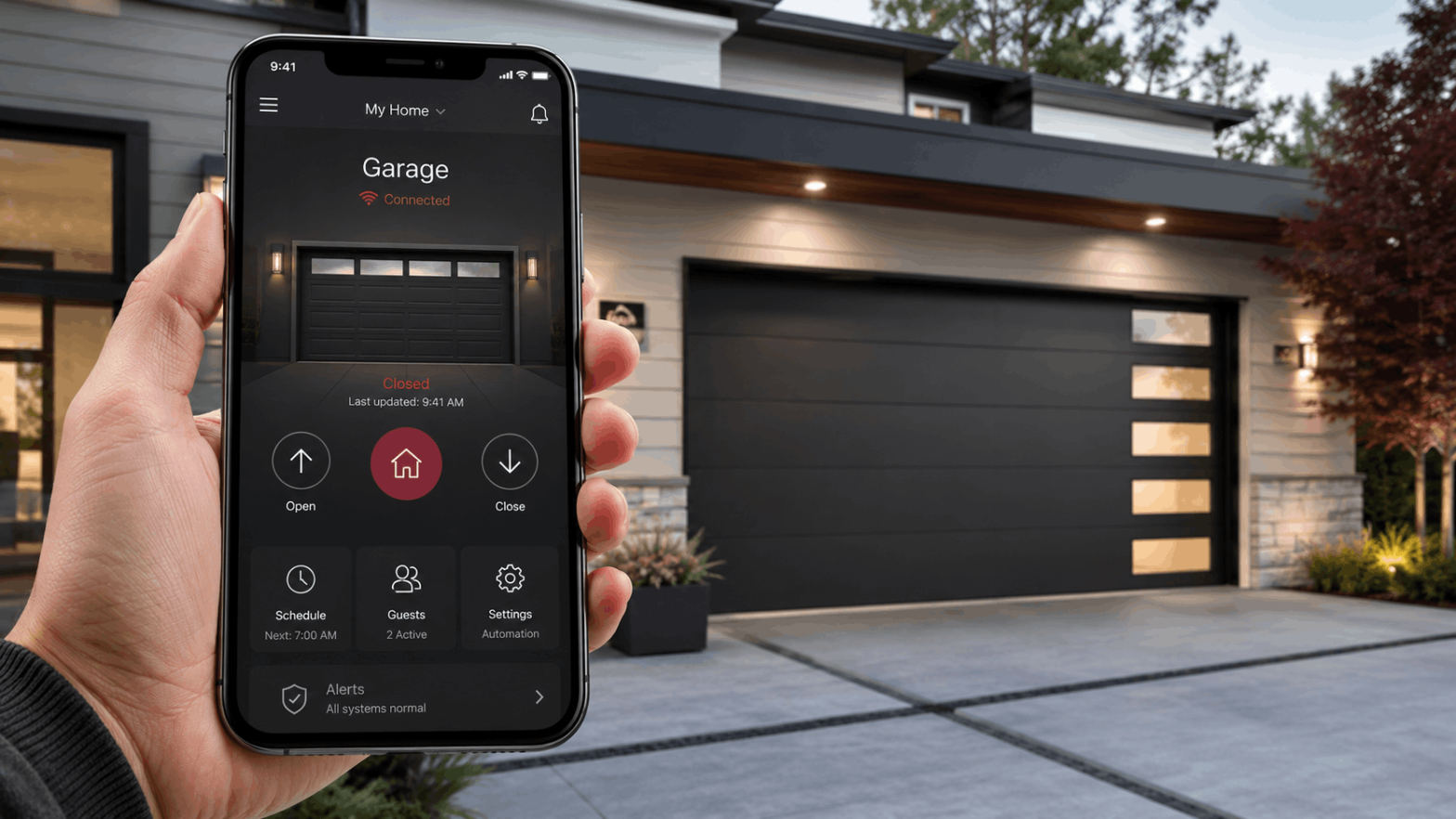
Smart Garage Door Openers: The Complete Guide to Wi-Fi, Apps & Home Automation
Your garage door is the largest, heaviest, most-used door in your home — and for most homeowners, it’s still controlled by a 30-year-old plastic remote that lives in a cupholder. A modern smart garage door opener changes that. Open the door from your phone before you pull in the driveway. Give the dog walker a one-time code. Get a ping if someone leaves the door open overnight.
If you’ve been thinking about upgrading, this guide walks through how smart openers work, what features actually matter, and how to choose the right one for your home.
What Is a Smart Garage Door Opener?
A smart garage door opener is simply an opener with built-in Wi-Fi (and sometimes Bluetooth) that connects to an app on your phone. Once connected, you can:
- Open and close the door from anywhere with a cell or internet signal
- Get real-time alerts when the door opens or closes
- Set schedules (auto-close at 10 p.m., for example)
- Grant access codes to family, neighbors, contractors, or delivery drivers
- See history — who opened the door, and when
Some smart openers integrate with Amazon Alexa, Google Home, Apple HomeKit, and even your car (myQ-compatible vehicles can open the door automatically as you approach).
The Real Benefits — Beyond the Cool Factor
Smart openers aren’t just a gadget. The day-to-day wins are practical:
- Peace of mind. No more “did I close the garage?” panic on the drive to work. Open the app, confirm, and close it if needed.
- Safer kid drop-off / pickup. Let them in without giving out a code, then close behind them automatically.
- Easier package delivery. Give Amazon or your dog walker a one-time code that expires automatically.
- Lower break-in risk. A door left open by mistake is a top entry point for theft. Smart alerts close that gap.
- Power-outage safety. Smart openers with battery backup keep working when the grid doesn’t — a big deal during Tennessee and Alabama storm season.
Key Features to Look For
Not every smart opener is created equal. Here’s what actually matters:
1. Drive Type
- Belt drive — Quietest. Ideal for homes with bedrooms or living spaces above or near the garage. Highly recommended.
- Chain drive — Most affordable, but noticeably louder. Fine for detached garages.
- Jackshaft / wall-mount — Mounts on the wall beside the door instead of overhead. Frees up ceiling space and is one of the quietest options. Excellent for high or vaulted garage ceilings.
2. Horsepower / Lifting Force
- ½ HP — Standard single-car doors
- ¾ HP — Standard two-car or insulated single doors (most common upgrade)
- 1+ HP — Heavy custom, wood, or oversized doors
3. Battery Backup
Look for this if you live anywhere with frequent power outages — which is most of North Alabama and Middle Tennessee. Backup batteries typically last for 20–50 cycles during an outage.
4. Smart Home Integration
- myQ (LiftMaster/Chamberlain) — The largest smart garage ecosystem. Works with Amazon Key, Tesla, Ring, Google, and Walmart InHome.
- Apple HomeKit — Native Siri and Home app control.
- Amazon Alexa / Google Home — Voice control and routines (“Hey Google, close the garage”).
5. Lighting, Cameras & Sensors
Newer openers include LED panels, integrated cameras, and motion sensors — turning the opener into a small smart-home hub. A built-in camera is great for confirming kids got home or that a package made it inside.
Can You Upgrade Without Replacing the Whole Opener?
Sometimes, yes. If your existing opener is reasonably new and mechanically sound, an add-on smart hub (like the myQ Smart Garage Hub) can give an “older” opener app control for a fraction of the cost of a full replacement.
That said, if your opener is more than 10–12 years old, makes grinding noises, or doesn’t have modern photo-eye safety sensors, a full replacement is the smarter play. Newer openers are quieter, more efficient, and far safer.
Installation: DIY or Pro?
You’ll find smart openers on big-box shelves with “easy install” stickers — but here’s the truth: the installation is where most things go wrong. Springs, headers, rail length, sensor wiring, force limits, and travel calibration all need to be set correctly, or the door is loud, unsafe, or short-lived. Professional installation also typically includes disposal of your old opener, hardware checks on the door itself, and a full safety test — none of which DIY guides cover well.
If you’re in Huntsville, Nashville, Franklin, Knoxville, Chattanooga, or any of our service areas, we’ll install your new opener, sync the app, set up smart-home integrations, and walk you through the features before we leave.
Smart Garage Door Opener FAQs
Q: Will a smart opener work with my existing garage door? A: In almost all cases, yes. Smart openers attach to standard residential garage doors.
Q: Does it need Wi-Fi to operate the door? A: No — your wall button and remote still work without internet. You just lose the smart features until Wi-Fi is back.
Q: How secure are smart openers? A: Modern openers use rolling codes (a new encrypted code every press) and encrypted app connections. They’re more secure than 1990s remotes.
Q: Can I control multiple garage doors? A: Yes. Most apps support multiple doors at one home, and even multiple homes.
Q: What about Wi-Fi range? A: Detached garages or far corners of a property sometimes need a Wi-Fi extender or mesh node nearby. We can advise during installation.
Ready to upgrade? Call or message Rose Quality Garage Doors and we’ll help you pick the right opener for your door, your home, and how you actually use your garage.